
journal entry – june 2026
The Rooms That Move You: Inside the 2026 Southeastern Designer Showhouse
Suzanne Kasler, Kim Mauney, Claudia Stimmel and Atlanta’s luxury designers — François & Co. goes inside the 2026 Southeastern Designer Showhouse in Chastain Park.
There are homes you walk through and homes that walk through you. This piece is dedicated to the second kind.
I’ve been in a lot of beautiful homes. It’s part of what I do, and I’m grateful for it every day. But every so often you step through a front door and something shifts… the proportions feel right, the light lands differently, and you find yourself slowing down without quite knowing why. That’s what happened when I walked through the doors of Atlanta Homes & Lifestyles‘ 2026 Southeastern Designer Showhouse, now in its 11th year and arguably its most ambitious. This year, it was all in service of Solidarity Sandy Springs.
I’m Lindsay Fournier, VP of Sales and Marketing at François & Co., and I’ve spent my career at the intersection of craft and architecture. I work with designers and architects on the elements that give serious interiors their bones: the mantels, the range hood, the stone, the flooring. The things that stay when everything else changes. This showhouse gave me the chance to see what happens when twenty designers pour genuine love into a space, each room a different expression of the same question: what does it mean to make something beautiful that lasts?
These are the rooms that stayed with me.
The Foyer: Where It All Begins
You look up first. That is what this entry demands.
Architect Linda MacArthur added a groin vault to the foyer and finished it in Venetian plaster, a decision that sets the tone for the entire home. The planes of the vault meet at the ceiling with quiet precision, and the light in that space is unlike any other room in the house: soft, luminous, alive in the way that only Venetian plaster can be. A single antique lantern hangs at its center. Below, a chequered stone floor, tumbled and aged, each tile carrying its own variation of tone and surface. Before you have seen a single room, you understand that someone made intentional decisions here.
“It does feel like the house has been there,” MacArthur said, “even though it is very contemporary.” That quality is among the rarest things in residential architecture. You cannot manufacture it. You earn it, decision by decision, from the vault overhead to the stone beneath your feet.
The Room That Calls You In
The foyer sets the tone. But something beyond it pulls you forward.
It was the kitchen that demanded the eye — specifically what was rising above the range. A reeded brass hood, its surface worked in such detail that you wanted to reach out and touch it. Warm, considered, impossible to ignore. Walking into that kitchen felt like a welcoming handshake from the house itself.
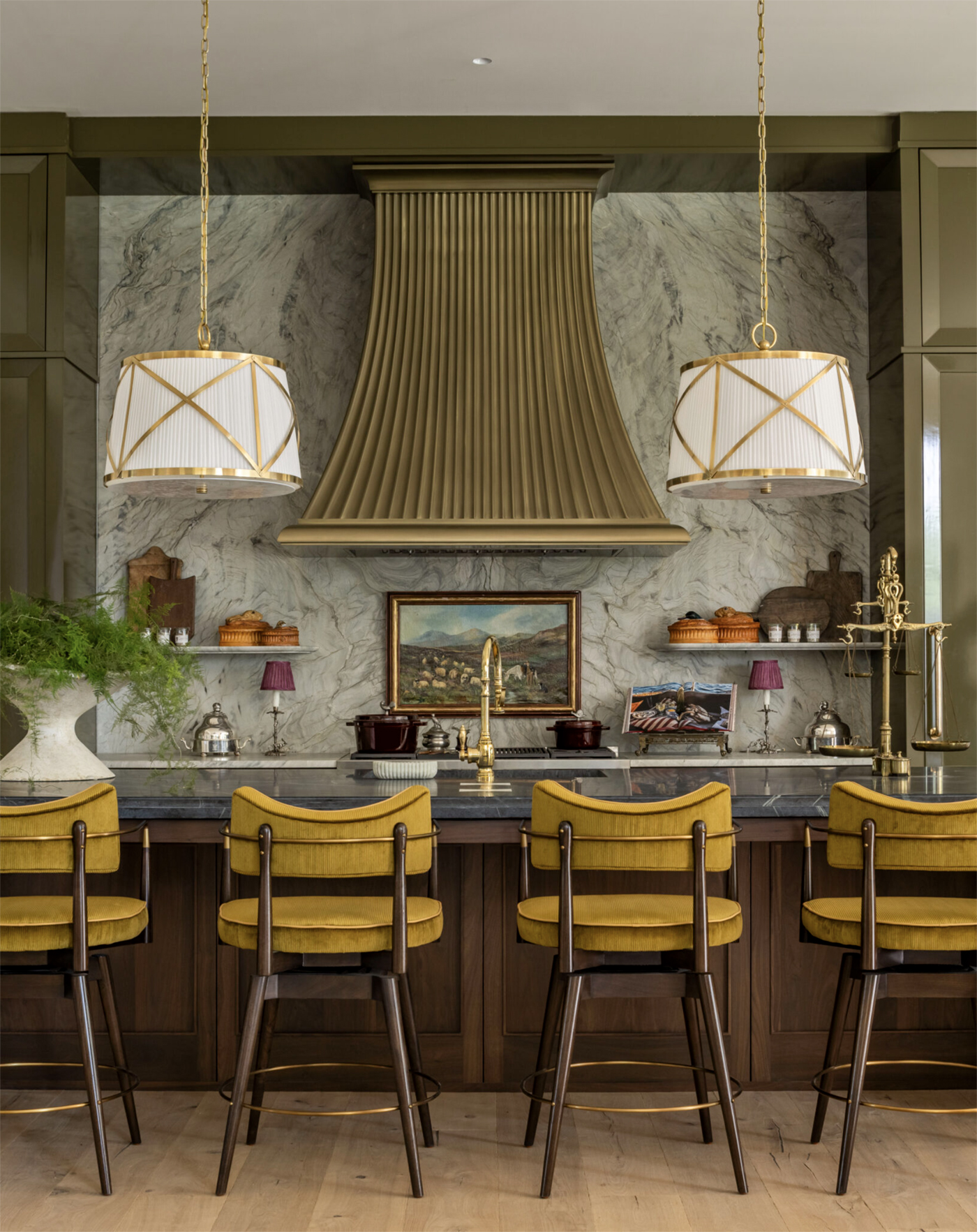
“It gives the space a heartbeat,” said designer Claudia Stimmel, and she was right. The textured dark stone island, the butterfly joints inlaid in white marble, the polished brass sink, the custom cabinets lacquered in cardamom, a color that shifts from earthy green to soft sage depending on the light. All of it organized around that hood the way a room organizes itself around a great piece of art. It was the first thing you saw and the last thing you thought about. The hood is the Protégé by François & Co., finished in a new brass patina that catches and holds the light in a way that feels less like a surface and more like a presence.
Behind it, something equally considered. The butler’s pantry, or scullery, has become a different room entirely in the finest homes. It’s no longer a place to store things, but a space that demands the same architectural attention as the kitchen. From the dark cabinetry, to a leathered stone counter I genuinely wanted to run my hands across, a second oven, a second sink, and an espresso machine I nearly tried to take home – This is where the real cooking happens, and the design knows it.
The mantel everyone asked about
The living room designed by Kim Mauney had been quietly waiting. It earned your attention gradually — layered textiles, a 17th-century Italian barber’s chair pulled close to the hearth, a portrait by Trine Søndergaard above it. And then the mantel that stopped you entirely.
A François & Co. Valentine in hand-pressed scagliola marble, its frieze dense with cherubs, mythological figures, horses and riders set within medallions — a surface that tells a story you want to lean in to read. I was told it was the most commented-on, most asked-about piece in the entire home. I’m not surprised. I watched visitors slow down in front of it and look closer, the way people slow down in front of paintings they didn’t expect to move them.
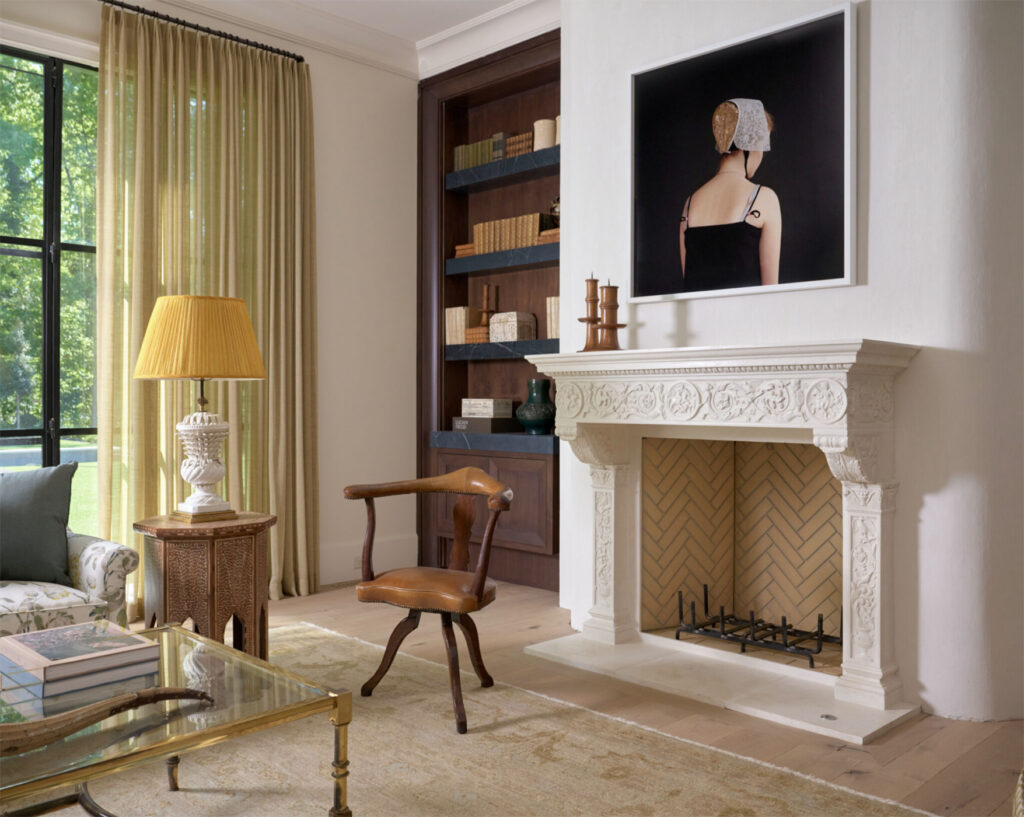
From across the room it reads as something that has simply always been there. And then you notice the walls curving softly beside it, embracing the fireplace without competing. A detail so subtle you might not consciously register it, but one that gives the whole room a quality that’s impossible to forget.
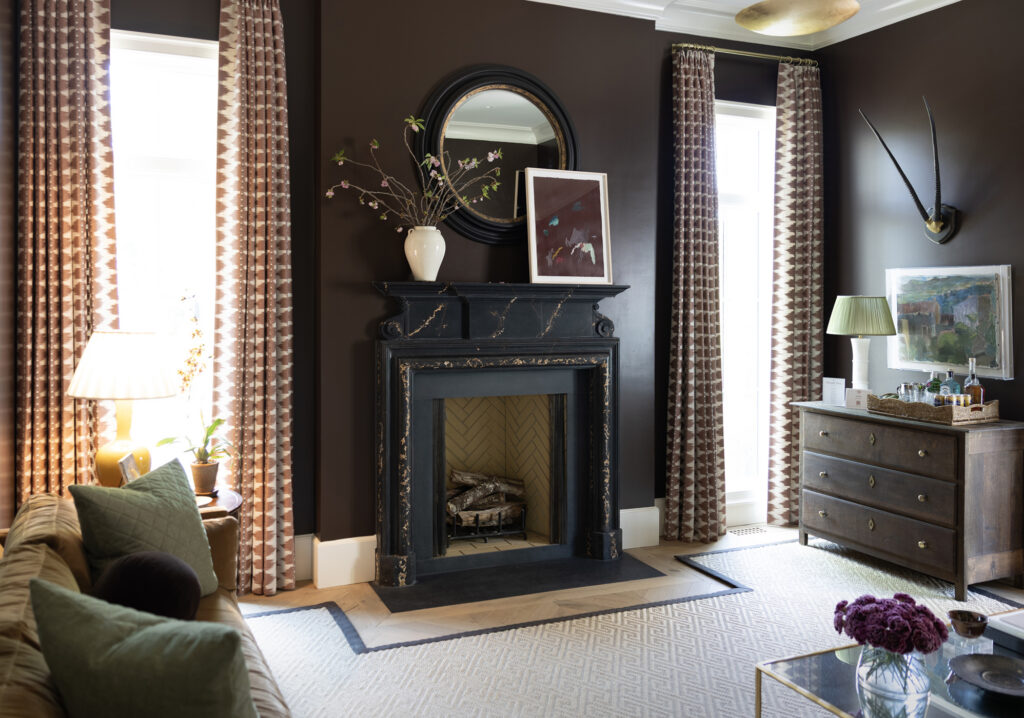
From there, you pass into the study painted in a deep almost-black brown that makes the space feel like an exhale. Dark enough to be a retreat, inviting enough for deep reflection. Here, the Carlisle, another François & Co. piece makes a statement. Its deep black stone threaded with dramatic gold veining, achieved by the artisan dragging pigments through the mold, holds its own against those dark walls. Where the living room mantel commands, this one contemplates. It is exactly right for a room designed to make you want to stay, ponder and admire.
A room of one’s own
Tucked above the main floor, the in-law suite is the kind of space that makes you want to close the door behind you.
Frederick Morelli was leaving for Europe the day he learned he would be designing this space. So his entire vision took shape in motion — Turkoman and Shiraz rugs chosen in Istanbul, fabrics seen in European showrooms, antique shutters from a Normandy château repurposed as closet doors that somehow fit the space perfectly.
The room became exactly what he intended. A private oasis. From the canopied bed to the mohair throws to the antique gilded mirrors — it felt like a five-star hotel in Europe that you never wanted to leave. Everything felt gathered over a lifetime, assembled by someone with a collector’s instinct for the rare and the quietly beautiful.
I couldn’t help but notice that the brass fittings throughout the kitchenette and bathroom were already beginning to develop the water spots and variation that unlacquered metal accumulates in a living space. Most people would reach for a cloth. I stopped and admired its beauty. That patina is not imperfection. It is the room already becoming itself.
Where The House Finds Itself
And then, finally, the oversized covered porch.
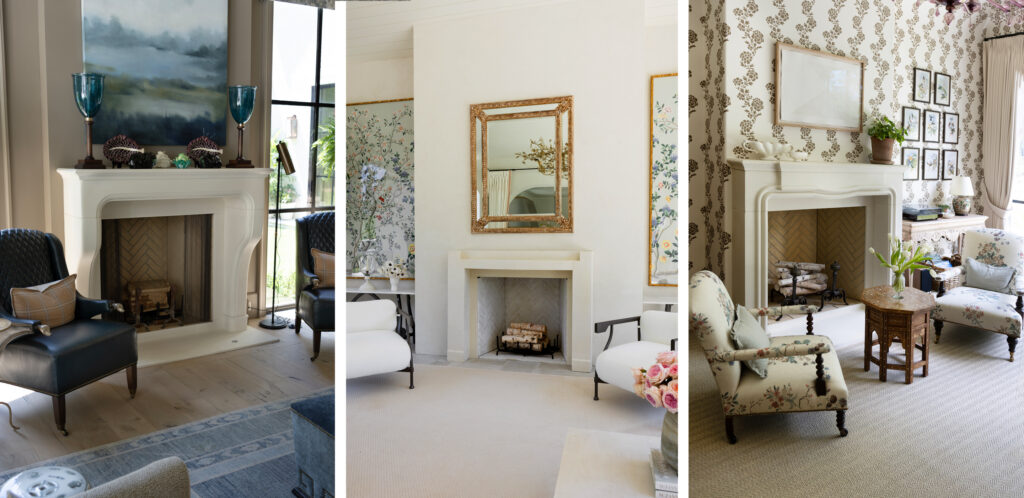
Suzanne Kasler designed this space, and it is the room I kept returning to. If Mother Nature had a living room, it would look like this. Cherry blossom branches reaching toward the ceiling. A de Gournay botanical panel on the wall, framed in gold. There was a gentle feminine strength in every detail. And at the center of it all, the François & Co. Hermes mantel — pure Art Deco restraint, a curved shelf beneath a recessed frieze. No ornament, no narrative. Just the authority of a beautiful line.
Linda MacArthur said she wanted this house to feel “both formal and relaxed at the same time.” Standing in Kasler’s porch, looking out past the arched columns to the herb garden and the pool beyond, I understood exactly what she meant. The formality is in the bones — the proportions, the plaster, the stone. The relaxation is in how it all breathes and lives. A house designed not for a season, but for a lifetime.
In The End, You Get What You put in
I’ve learned that the finest homes don’t ask to be admired. They ask you to stay. To slow down. To notice what someone cared enough about to get exactly right. This house did all three. Every mantel, every surface, every room was curated by designers who poured something genuine into their work — and it shows.
That is what I came away with. A palpable feeling. The feeling of a house that was made with love, for a life well lived. And the quiet reminder that when craft and intention meet, something extraordinary happens.
These are the rooms that moved me and have stayed with me. If they inspired you, we would love to help you bring that feeling into your own spaces. Visit us at francoisandco.com or stop by one of our showrooms to see our collections in person.
Your friend in design,
Lindsay